Maryland's Shame
The Baltimore Sun
Maryland's "Snake-pits"
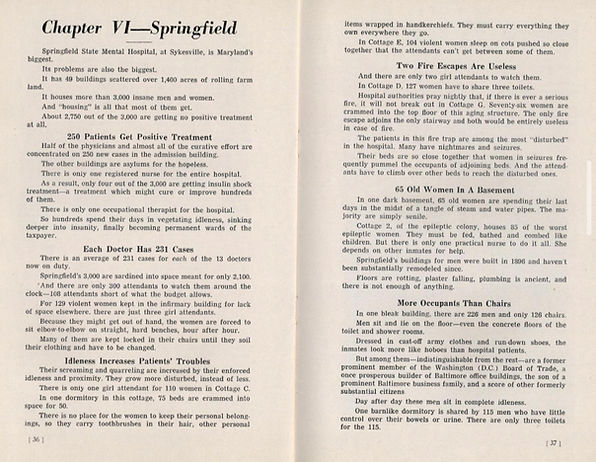
In 1949, the Baltimore Sun released a groundbreaking investigative series titled “Maryland’s Shame.”
This exposé unveiled the deplorable conditions inside Maryland’s mental hospitals—conditions so disturbing that they shocked the public and reshaped the future of psychiatric care in the state.
Reporters visited institutions across Maryland and documented overcrowded wards, patients sitting on dirty floors, individuals restrained tightly in chairs, and isolation rooms filled with emaciated patients who stared blankly into space. Staff described impossible patient loads and harrowing stories of neglect that had become routine.
The greatest shock came from Springfield, once considered the state’s “crowned jewel.” Its reputation made the horrific images emerging from inside its walls even harder for the public to comprehend.
The Impact of War
Although the scenes were horrifying, the collapse was not without cause.
Much of the crisis was fueled by World War II.
Before wartime, Maryland’s mental hospitals were adequately funded, staffed, and regularly inspected. But as the war intensified:
-
Many employees left to serve, causing staffing levels to plummet.
-
Thousands of returning veterans exhibited symptoms of what we now recognize as PTSD, a condition poorly understood at the time.
-
Veterans were placed into institutional care, swelling patient populations—particularly in men’s wards—far beyond what facilities could safely support.
The combination of rapidly increasing patient numbers, drastically reduced staffing, and aging facilities created a perfect storm of neglect and overcrowding.
The Public Reaction
When the Baltimore Sun published its photos and testimonies, public reaction was swift and decisive.
Outrage spread across the state, and Marylanders demanded immediate intervention. The political pressure was too strong for lawmakers to ignore.
The Reforms
In response, Maryland enacted sweeping reforms:
-
Funding was restored and expanded
-
Old, unsafe buildings were renovated
-
Staffing levels were rebuilt
-
Two new large facilities—one for men, one for women—were constructed to ease crowding
Over time, conditions steadily improved. Reports of severe neglect diminished, and the hospital system entered a period of renewed stability.
After the Crisis
By the 1950s, the horrors that had defined the era of Maryland’s Shame had largely subsided.
Maryland’s hospitals regained stability, and for a time, a more humane and attentive model of institutional care took hold.
Vietnam and the Final Unraveling
Two decades later, history began to repeat itself.
The Vietnam War placed new pressures on the mental-health system, echoing what had happened in the 1940s. Once again, large numbers of veterans returned with serious psychological trauma, and institutions struggled to keep up.
But this time, the world had changed.
Unlike the 1940s—when the public saw only photographs—television crews now carried portable video cameras.
News stations could walk directly into institutions and record moving, unfiltered footage of conditions inside. The resulting images were far more haunting, immediate, and impossible to ignore.
One of the most influential investigations took place at Pennhurst State School & Hospital in Pennsylvania.
The video exposé, widely broadcast, revealed extreme neglect, abuse, overcrowding, and inhumane conditions. The footage became a national shockwave.
The reporting triggered a landmark legal battle—the Pennhurst case, which ultimately reached the U.S. Supreme Court.
The case challenged the legality of warehousing individuals with disabilities in institutions that could not provide humane or adequate care.
The Supreme Court’s decisions, combined with public outrage, became the tipping point.
What followed was the rapid downfall of institutional care across the country.
States began closing their large mental hospitals, shifting instead toward community-based treatment—an enormous and controversial transformation that forever changed the landscape of American mental health care.
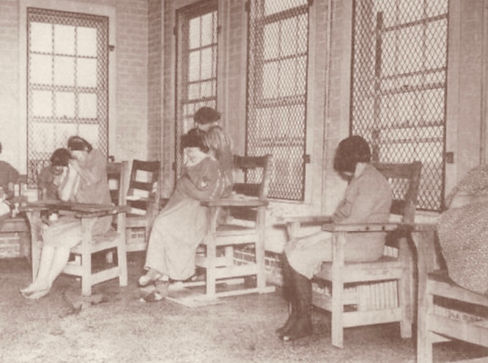
Locked In Place
These female patients at Springfield's Epileptic Colony were forced into straight jackets and placed in locked chairs. Sitting aimlessly for days, no end in sight.
Photo: Maryland's Shame (thebaltimoresun)
1 Registered Nurse
At the time that Maryland's Shame was released, Springfield only had 1 Registered nurse working at the entire institution. Though this is daunting, this ratio does not include LPN's (Licensed Practical Nurses), affiliates (nurses in training), or volunteers that helped on the wards of the hospital.
Ratio: Maryland's Shame (thebaltimoresun)


Beds on Beds
This photo depicts a basement ward at the Men's Group. Rows of tightly placed beds can be see in the entire room. This picture was meant to show just how many patients Springfield was housing just in one ward alone.
Photo: Maryland's Shame (thebaltimoresun)
Standing Room Only
This photo is captioned with this:
"There are 226 men, but only 126 chairs in this bare, prison-like "dayroom" at Springfield State Hospital. Those who have no chairs spend hours sitting or lying on the floor. There is nothing else for them to do."
Photo: Maryland's Shame (thebaltimoresun)