

~ Epileptic Colony (Clark Circle): 1924 ~
Epileptic Colony (Clark Circle) History
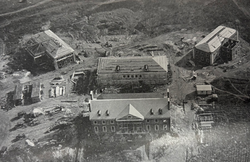
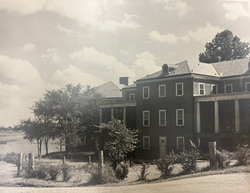
Construction of the Epileptic Colony began in 1923, starting with the Administration Building, the patient Dining Hall—connected to the Administration Building by an enclosed glass walkway—and the first two patient cottages: Cottage No. 1 for men and Cottage No. 2 for women. The administration at Springfield, led primarily by Superintendent Dr. Joseph C. Clark, was strongly committed to separating “insane epileptics” from the rest of the hospital population. At the time, epileptic patients were thought to be disruptive, and the prevailing medical belief held that their fits and seizures necessitated specialized and isolated care.
It is important to note that in the early 20th century, a person did not need to have epilepsy to be classified as “epileptic.” The term broadly applied to individuals exhibiting involuntary movements—an umbrella category that would encompass a wide range of neurological conditions by modern standards. While two small epileptic cottages existed elsewhere on the hospital grounds prior to the construction of the colony—one in the Men’s Group (1905) and one in the Women’s Group (1911)—the creation of a dedicated and autonomous “epileptic colony” finally came to fruition under Dr. Clark’s determined advocacy. The complex soon earned the nickname “Clark Circle” in recognition of his efforts.
Design and Construction
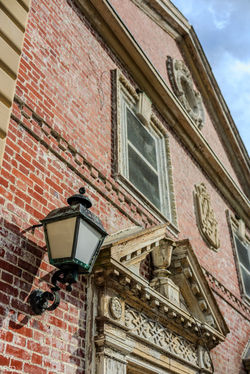
The Epileptic Group was arranged in a circular layout, with the Administration Building and Dining Hall forming the central axis and the patient cottages positioned around them in a balanced configuration. Compared to the larger hospital complexes, the buildings in the colony were noticeably smaller due to limited funding. Nevertheless, they retained the ornate moldings, architectural ornamentation, and thoughtful design philosophy that defined Springfield’s approach to humane institutional care.
The colony was divided equally between men and women. The Dining Halls and kitchen were designed specifically to maintain strict separation between the sexes, featuring two mirror-image dining halls—one male and one female—with a large shared kitchen situated between them.
Administration Building
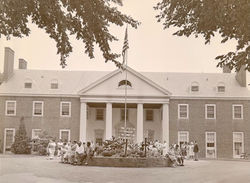
The first floor of the Administration Building housed offices, reception areas, and staff dining facilities. The second and third floors consisted of staff suites and apartments, complete with sitting rooms and additional service spaces. Many employees at Springfield lived on-site for extended periods, and the building’s arrangement reflected the hospital's emphasis on creating self-contained and functional staff environments.
Connected directly to the Administration Building was the patient Dining Hall, which served as the primary communal space of the colony and linked the two halves of the population by way of its central kitchen.
Patient Cottages (1–5)
The patient cottages were designed to meet the specific needs of epileptic patients while maintaining Springfield’s hallmark “homelike” aesthetic. Cottages No. 1 and No. 2, completed in 1923, formed the original nucleus of the colony.
First Floor
The first floors of the cottages contained:
-
A reception area
-
Lavatories and washrooms
-
Sunrooms and day halls
-
Comfortable, light-filled spaces intended to promote calm and well-being
Second Floor
The second floors included:
-
A changing room
-
Lavatory and washroom
-
One large open dormitory
A notable distinction between the Epileptic Group and the older hospital structures lies in their fire escape systems. While the Men’s and Women’s Groups utilized conventional stairwell fire escapes, the epileptic cottages featured narrow spiral slide fire escapes, which offered fast, direct evacuation outdoors and were considered advanced safety features for the time.
Expansion and Later Years
The Epileptic Group expanded steadily following its initial construction. Additions included:
-
Cottage No. 3 (Men) – 1928
-
Cottage No. 4 (Women) – 1928
-
Cottage No. 5 (Infirmary for Both Sexes) – 1937
Cottage No. 5 served as the infirmary for both men and women. Despite housing both sexes under one roof, the building was divided down the middle to ensure continued separation—even featuring two front doors, one for each side. With the completion of this final cottage, the circular formation was complete, fully realizing Dr. Clark’s vision for the colony.
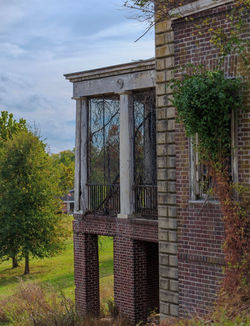
The Epileptic Colony remained active until the late 1980s, when hospital-wide downsizing began. After closure, the colony sat neglected for several years, becoming overgrown and deteriorated. In later years, however, efforts by the administration and community helped stabilize and beautify the site. Overgrowth was cleared, dead trees were removed, murals were painted onto window boards, and members of the Boy Scouts constructed benches throughout the circle to encourage public enjoyment of the architecture and landscape. Today, Clark Circle remains a significant and evocative part of Springfield’s historical legacy.
Clark Circle:
Historic Images
 |  |
|---|---|
 |  |
 |  |
 |  |
 |  |
 |  |
 |  |
 |  |
 |  |
Clark Circle:
Modern Images
 |  |
|---|---|
 |  |
 |  |
 |  |
 |  |
 |  |
 |  |